How many members does LinkedIn have?
On 28 October 2026, LinkedIn had more than 1.4 billion member accounts.
Source: LinkedIn Pressroom
Source: Microsoft Fiscal Year 2027 Q1 Earnings
Here are the LinkedIn member stats I’ve tracked. Some extra detail about the announcements (such as growth and revenue) are accessible via the links on the numbers in the table.
| Date | Members |
|---|---|
| 02 Aug 2012 | 174M |
| 01 Aug 2013 | 238M |
| 31 Jul 2014 | 313M |
| 31 Jul 2015 | 380M |
| 28 Apr 2016 | 433M |
| 31 Aug 2016 | 450M |
| 27 Oct 2016 | 467M |
| 25 Apr 2017 | 500M |
| 09 Aug 2018 | 575M |
| 31 Jan 2019 | 610M |
| 06 Aug 2019 | 645M |
| 29 Oct 2019 | 660M |
| 31 Jan 2020 | 675M |
| 30 Apr 2020 | 690M |
| 04 Aug 2020 | 706M |
| 27 Oct 2020 | 722M |
| 26 Jan 2021 | 738M |
| 27 Apr 2021 | 756M |
| 28 Jul 2021 | 774M |
| 26 Oct 2021 | 800M |
| 25 Jan 2022 | 810M |
| 26 Apr 2022 | 830M |
| 26 Jul 2022 | 850M |
| 25 Oct 2022 | 875M |
| 24 Jan 2023 | 900M |
| 25 Apr 2023 | 930M |
| 25 Jul 2023 | 950M |
| 24 Oct 2023 | 985M |
| 30 Jan 2024 | 1B+ |
| 27 Apr 2024 | 1B+ |
| 30 Jul 2024 | 1B+ |
| 31 Oct 2024 | 1B+ |
| 29 Jan 2025 | 1.1B+ |
| 01 May 2025 | 1.1B+ |
| 31 Jul 2025 | 1.2B+ |
| 30 Oct 2025 | 1.3B+ |
| 29 Jan 2026 | 1.3B+ |
| 29 Apr 2026 | 1.3B+ |
| 29 Jul 2026 | 1.3B+ |
| 28 Oct 2026 | 1.4B+ |
Microsoft stopped announcing exact membership growth numbers for LinkedIn after the platform reached 1 billion members. In late January 2025, an empty People search on LinkedIn returned “about 1,100,000,000 results”. LinkedIn no longer reports numbers on People searches, so we can’t use this method to see how many accounts there are.
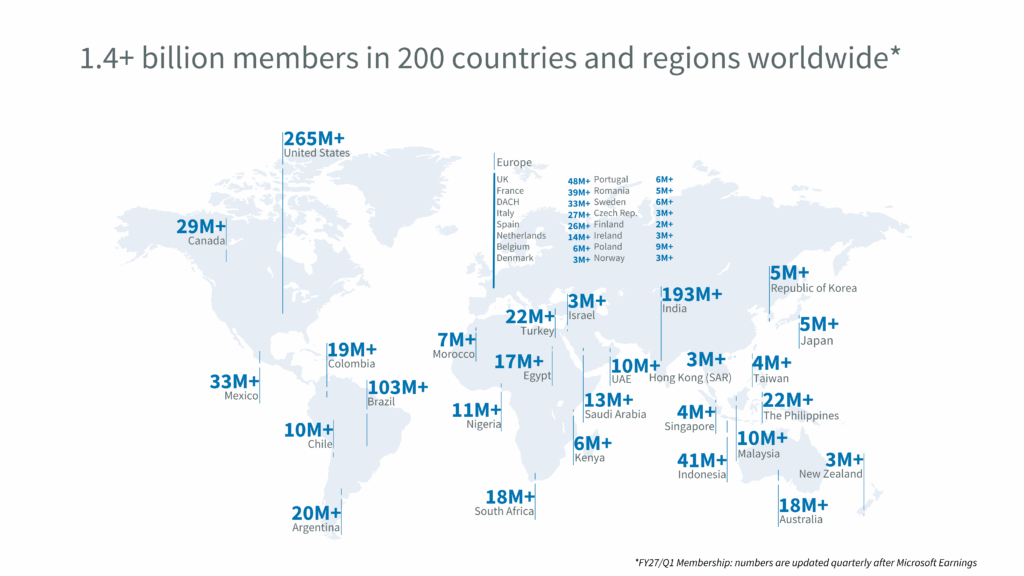
Top 5 countries on LinkedIn by accounts.
On 28 October 2026, the countries with most LinkedIn members (not all will be active users) were:
🇺🇸 265M+ USA
🇮🇳 193M+ India
🇧🇷 103M+ Brazil
🇬🇧 48M+ UK
🇮🇩 41M+ Indonesia
To take the US as an example, these figures suggest that about 76% of the US population overall has a LinkedIn account, which is ambitious reporting to say the least. Also, 18% of the US population is under 16 and therefore can’t have a LinkedIn account.
LinkedIn are obviously reporting on the number of accounts, which will include duplicates, fakes, dormant accounts, etc. See my calculation below for the number of active members on LinkedIn.
Global membership by region:
427M+Asia Pacific450M+Europe, Middle East & Africa296M+North America233M+South & Central America
Latest members map, via LinkedIn Pressroom:
See previous LinkedIn membership maps
LinkedIn performance over latest quarter.
10M+members using LinkedIn AI-powered job search daily25Kcustomers using agentic hiring solutions15%year on year increase in time spent viewing content in the feed10%growth in LinkedIn Talent Solutions25%year on year increase in paid video ads63%year on year increase in ads featuring creators121%year on year increase in Premium company pages
Every minute on LinkedIn:
110people add a new role to their profile~9Kjob applications are submitted2M+feed updates are viewed19K+connections are made~119hours of learning content is consumed
LinkedIn member growth to 1B accounts.
Here’s a graph of the above table from 600M accounts to 1B accounts (January 2019 to January 2024).
(I write “accounts” rather than “members” because I still think there are a lot of fake and duplicate accounts on the platform, so these numbers don’t represent the number of real people on LinkedIn.)
Microsoft stopped sharing exact numbers once LinkedIn reached 1B accounts, but growth is generally at around 25M per quarter.

How many active users are on LinkedIn?
The absolute number of members on LinkedIn doesn’t matter as much as the number of active members.
LinkedIn don’t publish details of active members across the whole platform but they do have to publish details about the activity of LinkedIn members in the European Union.
Using that information and doing some extrapolation means that we can make a decent approximation of the real number of active users.
I’ve put together the numbers in the table below via the Digital Services Act Transparency Report for August 2026 and the numbers reported via LinkedIn’s Pressroom.
| Country | Monthly active | Total users | Proportion active |
|---|---|---|---|
| Belgium | 1.9M | 6M | 32% |
| Czechia | 0.8M | 3M | 27% |
| Denmark | 1.5M | 3M | 50% |
| Finland | 0.9M | 2M | 45% |
| France | 12.6M | 38M | 33% |
| Ireland | 1.2M | 3M | 40% |
| Italy | 6.5M | 26M | 25% |
| Netherlands | 5.4M | 13M | 42% |
| Poland | 2.5M | 9M | 28% |
| Portugal | 1.6M | 6M | 27% |
| Romania | 1.0M | 5M | 20% |
| Spain | 6.1M | 25M | 24% |
| Sweden | 2.2M | 6M | 37% |
| Summary | 44.2M | 145M | 30% |
The above table shows the number of monthly active users in various EU countries during the period January 2026 and June 2026, along with the total number of users in those countries based on what the Pressroom reported in the middle of 2026. (I’m not reporting on all EU countries here, because only some of their total user figures are shown on the Pressroom map.)
Dividing the number of active users by the total number of users gives us the proportion of active users as a percentage per country.
The final line of the table summarises that there were 44.2M total active users out of the 145M total users, meaning an overall activity rate of 30%.
If we extrapolate this activity percentage to the whole world, that would imply that there are approximately 420M active LinkedIn users (30% of 1.4B accounts).
But what does active really mean? It’s hard to know. In the Transparency Report, LinkedIn uses the phrases “monthly average logged-in users” and “Monthly Active Recipients of the Service” without going into detail about what activity really means.
“Activity” might be as basic as saying that someone has logged in and spent a few seconds browsing the site, in which case it’s not much of a measure of anything important.
Why these numbers matter.
LinkedIn is still a great place to reach your audience without having to pay for ads, but good levels of free organic reach have been decreasing since 2023.
To buffer yourself from the decline of organic reach, it’s a good idea to build your audience now.
My best advice: leave more comments on interesting and relevant conversations happening on LinkedIn posts, and move those conversations into the direct messages whenever possible.
DMs are not affected by anything that happens to the LinkedIn algorithms, and that’s the sort of insurance policy I like.